The Device Mesh
The device mesh moves beyond the traditional desktop computer and mobile devices (tablets and smartphones) to encompass the full range of endpoints with which humans might interact. As the device mesh evolves, Gartner expects connection models to expand and greater cooperative interaction between devices to emerge. We will see significant development in wearables and augmented reality, especially in virtual reality.
2: Ambient User Experience
All of our digital interactions can become synchronized into a continuous and ambient digital experience that preserves our experience across traditional boundaries of devices, time and space. The experience blends physical, virtual and electronic environments, and uses real-time contextual information as the ambient environment changes or as the user moves from one place to another.
Organizations will need to consider their customers’ behavior journeys to shift the focus on design from discrete apps to the entire mesh of products and services involved in the user experience.
3: 3D-Printing Materials
We’ll see continued advances in 3D printing with a wide range of materials, including advanced nickel alloys, carbon fiber, glass, conductive ink, electronics, pharmaceuticals and biological materials for practical applications expanding into aerospace, medical, automotive, energy and the military.
Recent advances make it possible to mix multiple materials together with traditional 3D printing in one build. This could be useful for field operations or repairs when a specific tool is required and printed on demand. Biological 3D printing — such as the printing of skin and organs — is progressing from theory to reality; however, politicians and the public don’t have a full understanding of the implications.
4: Information of Everything
Everything surrounding us in the digital mesh is producing, using and communicating with virtually unmeasurable amounts of information. Organizations must learn how to identify what information provides strategic value, how to access data from different sources, and explore how algorithms leverage Information of Everything to fuel new business designs.
5: Advanced Machine Learning
Advanced machine learning is what makes smart machines appear “intelligent” by enabling them to both understand concepts in the environment, and also to learn. Through machine learning a smart machine can change its future behavior. This area is evolving quickly, and organizations must assess how they can apply these technologies to gain competitive advantage.
6: Autonomous Agents and Things
Advanced machine learning gives rise to a spectrum of smart machine implementations — including robots, autonomous vehicles, virtual personal assistants (VPAs) and smart advisors — that act in an autonomous (or at least semiautonomous) manner. This feeds into the ambient user experience in which an autonomous agent becomes the main user interface. Instead of interacting with menus, forms and buttons on a smartphone, the user speaks to an app, which is really an intelligent agent.
7: Adaptive Security Architecture
The complexities of digital business and the algorithmic economy, combined with an emerging “hacker industry,” significantly increase the threat surface for an organization. IT leaders must focus on detecting and responding to threats, as well as more traditional blocking and other measures to prevent attacks.
8: Advanced System Architecture
The digital mesh and smart machines require intense computing architecture demands to make them viable for organizations. They’ll get this added boost from ultra-efficient-neuromorphic architectures. Systems built on graphics processing units (GPUs) and field-programmable gate-arrays (FPGAs) will function more like human brains that are particularly suited to be applied to deep learning and other pattern-matching algorithms that smart machines use. FPGA-based architecture will allow distribution with less power into the tiniest Internet of Things (IoT) endpoints, such as homes, cars, wristwatches and even human beings.
9: Mesh App and Service Architecture
The mesh app and service architecture are what enable delivery of apps and services to the flexible and dynamic environment of the digital mesh. This architecture will serve users’ requirements as they vary over time. It brings together the many information sources, devices, apps, services and microservices into a flexible architecture in which apps extend across multiple endpoint devices and can coordinate with one another to produce a continuous digital experience.
10: Internet of Things Architecture and Platforms
IoT platforms exist behind the mesh app and service architecture. The technologies and standards in the IoT platform form a base set of capabilities for communicating, controlling, managing and securing endpoints in the IoT. The platforms aggregate data from endpoints behind the scenes from an architectural and a technology standpoint to make the IoT a reality.

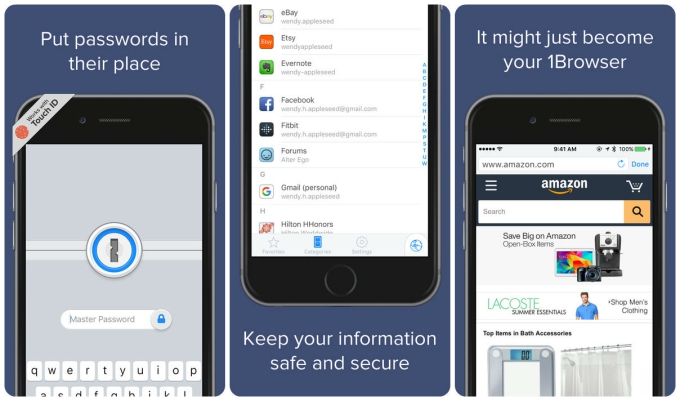 One of the most well known names in the business, 1Password makes it simple to store usernames and passwords, as well as credit card information, addresses and even simple notes. It’ll easily generate new passwords for you before filling websites with the information in a couple of taps. A pro service offers additional categories such as bank accounts, and driver’s licenses, for a fee.
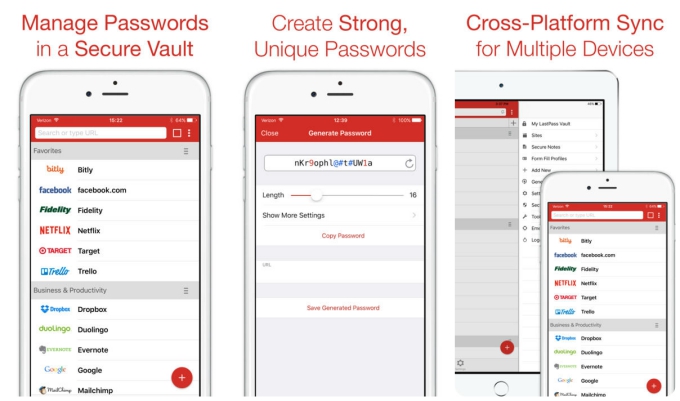 LastPass simply requires you to remember one password, before doing the rest for you, automatically filling in your logins, and even allowing you to sign in via TouchID. Offering a place to store membership details, IDs, software keys and pretty much everything else you want to keep private, the app is a Swiss Army Knife of security features. It’ll even give you a heads up when other sites or services have been hacked, reminding you to be extra vigilant.
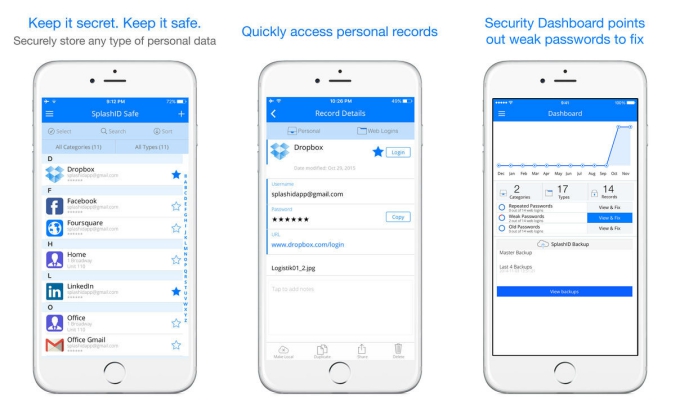 SplashID is a well established password storage system, providing a place for all your secure data. With a choice of cloud syncing or Wi-Fi syncing, you can be in complete control. Secure sharing also means you can share content with other SplashID users, plus there are attachment options and a photo capturing service.
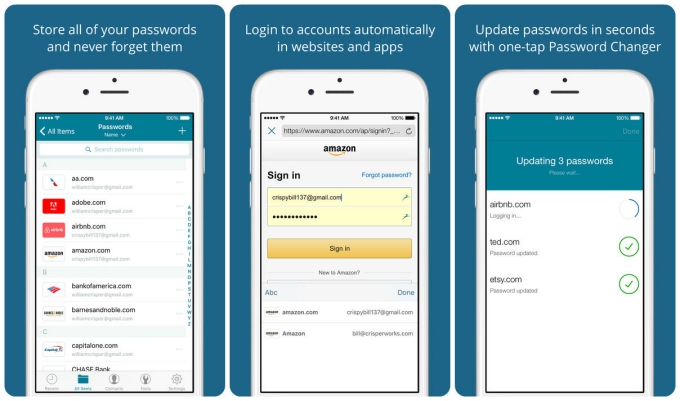 Dashlane offers a stylish interface while keeping your passwords secure. It syncs across all devices easily, while encrypting your data at all times. Autofill login makes browsing different sites a breeze, while still allowing you to use highly complex passwords. An auto-lock feature keeps things safe even if you lose your iOS device, too.
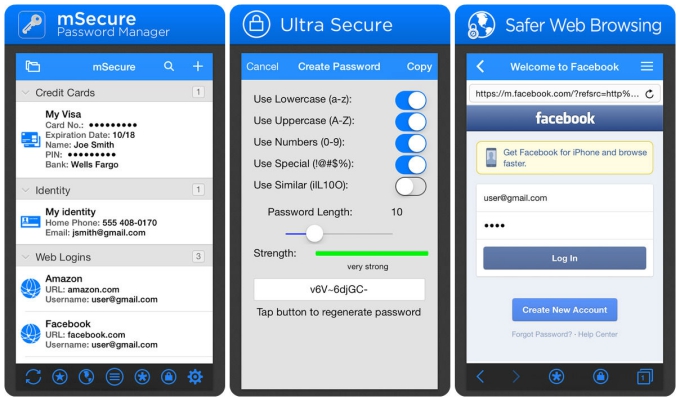 Offering a one time price rather than requiring a subscription, mSecure Password Manager provides the typical features of password generation and 256bit encryption. An auto-backup reminder keeps on top of things, while a series of templates makes it super easy to enter new data and information.
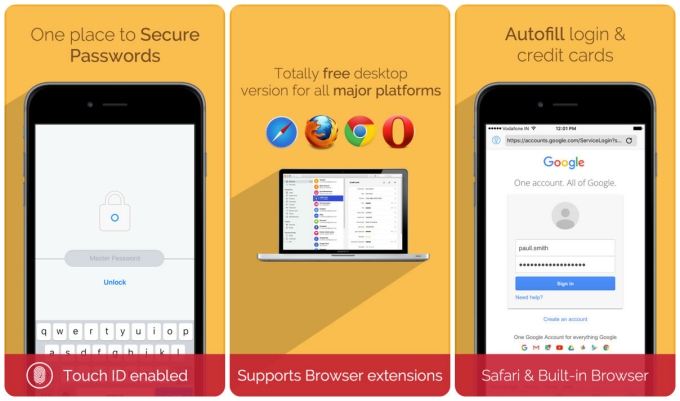 Available on multiple platforms, Enpass Password Manager embraces TouchID making it easy to unlock your content at a tap of your finger. No subscription is required with a number of preset templates ensuring your data is easy to enter, before being kept secure. Folder support makes it a breeze to navigate too.
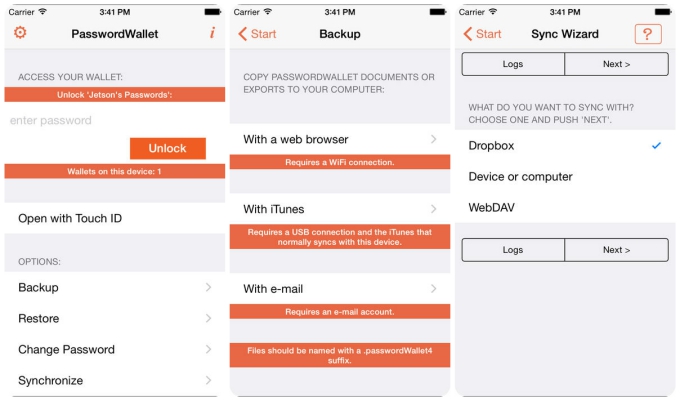 PasswordWallet prides itself on the fact you don’t require iTunes or any special software to easily backup, restore, and view your data on any PC, while also managing your passwords. It’ll easily sync up with PC or Mac, as well as work across multiple files and computers, being a particular advantage to more complex needs.
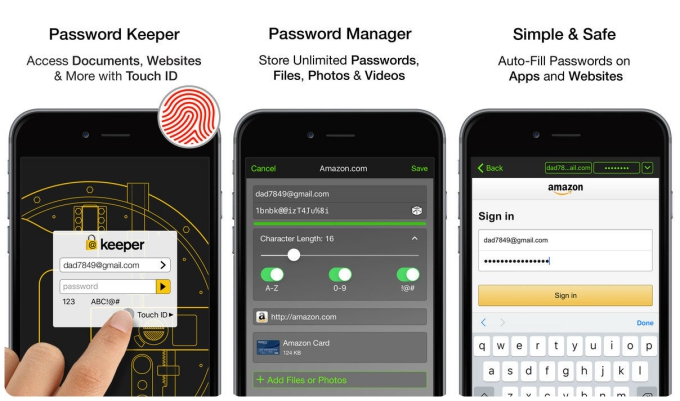 Keeper takes seconds to set up, storing unlimited number of passwords, only accessible via your fingerprint. It’ll generate new ones, as well as auto-fill content in apps and websites. You can store files, photos and videos within a private vault, ensuring everything on your phone is safely tucked away. Two-step verification can also be set up for added security.
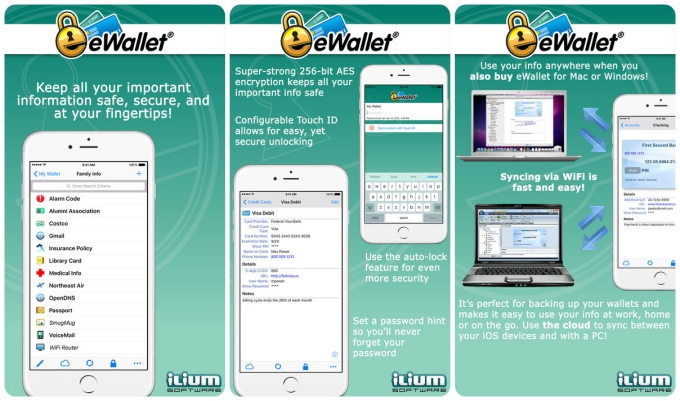 eWallet offers a place to store your passwords, credit cards, and bank account numbers all behind high end encryption. A password generator is included, along with an auto-locking feature, TouchID support, and extensive syncing functionality. It’s optimized for the iPad too, providing multitasking support for added ease.